
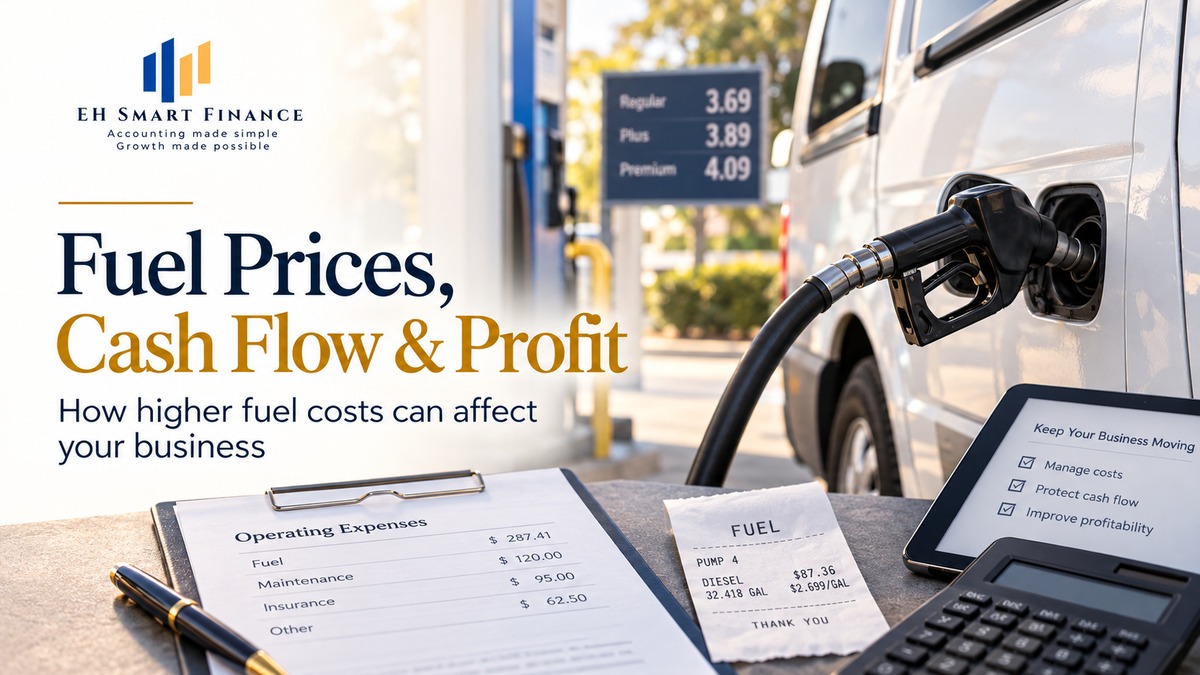
When fuel prices rise, it is easy to think of the increase as just another expense your business has to absorb.
But for many small businesses, the real impact goes far beyond the amount appearing on a gas station receipt. Higher gasoline or diesel prices can pressure cash flow, reduce profit margins, increase supplier costs and turn a job that once looked profitable into one that barely produces a return.
So the most useful question is not simply: “How much am I paying for fuel?”
It is: “How much are higher fuel costs changing the actual profitability of my business?”
Fuel costs can look very different depending on where you operate
According to the latest available AAA figures, the national average is approximately $4.31 per gallon for regular gasoline and $6.20 for diesel. Fuel prices change daily.
| Market | Regular gasoline | Diesel |
|---|---|---|
| U.S. national average | $4.31 | $6.20 |
| Los Angeles–Long Beach | $6.04 | $8.08 |
| Chicago | $4.54 | $6.17 |
| Orlando | $4.15 | $6.34 |
| Houston | $3.76 | $5.64 |
For a business owner, the important point is not which city has the highest price. It is understanding how much fuel your business consumes and how much of that additional cost your current pricing can absorb.
Higher fuel prices can quietly reduce profit
Consider a business that uses approximately 300 gallons of gasoline each month. A year ago, the national average for regular gasoline was roughly $3.18 per gallon. Today it is approximately $4.31.
At the same level of consumption, that is roughly $340 in additional monthly fuel expense, or more than $4,000 annually.
The effect can be significantly larger for diesel-dependent businesses. At 300 gallons per month, the increase can represent roughly $750 in additional monthly cost.
If your selling prices have not increased along with those costs, your margin is absorbing the difference.
Cash flow and profit are not the same thing
Fuel affects cash flow because the fuel has to be paid for immediately. It affects profitability because it increases the cost required to produce or deliver your service.
Consider a $500 job. Previously, the costs may have included $100 in materials, $40 in fuel and $200 in labor and other direct costs. That leaves $160 before other expenses.
If fuel for the same job now costs $70 and the customer still pays $500, that margin falls to $130. Revenue did not decline, but the same job generated less profit.
Which businesses are most exposed?
- Contractors
- Construction companies
- Landscaping businesses
- Cleaning companies
- Delivery and transportation services
- Businesses operating commercial vehicles or fleets
- Mobile service businesses and repair technicians
- Restaurants
But a company does not need to own vehicles to feel the effect. Suppliers and service providers are also paying more for transportation, which can show up through higher delivery fees, fuel surcharges, higher material costs and increased vendor pricing.
Are your existing jobs still profitable?
Suppose you quoted a project three months ago based on the costs you had at the time. The customer accepted a fixed price. By the time you perform the work, fuel and other operating costs have increased.
The question becomes: Is that job still producing the margin you expected when you quoted it?
Five numbers business owners should review
1. Monthly fuel expense
Compare several months. Do not evaluate the impact based on one fill-up. Look for the trend.
2. Fuel cost as a percentage of revenue
An additional $500 per month means something very different to a $20,000 business than to a $500,000 business. Context matters.
3. Profitability by customer, job or route
Two customers can produce the same revenue while generating very different profits. Distance, delivery frequency and travel time can change the economics of each account.
4. Gross margin
If direct costs increase while selling prices remain unchanged, gross margin can decline even while sales continue growing.
5. Working-capital requirements
If fuel, inventory and other operating expenses increase simultaneously, your company needs more cash simply to maintain the same level of activity.
Does this automatically mean you should raise prices?
Not necessarily. The first step is understanding what actually changed.
- Route optimization
- Consolidated deliveries
- Better scheduling
- Reducing unnecessary trips
- Supplier negotiations
- Service-area adjustments
- Improved purchasing practices
For other businesses, pricing may need to be reviewed. Depending on the industry and contracts involved, future agreements may also need to consider fuel surcharges, adjustment clauses, shorter quote-validity periods or distance-based pricing.
Ask this before sending your next quote
“Am I pricing this job using today’s costs—or the costs my business had six months ago?”
Your bookkeeping should help you see the answer
Current and properly organized financial records should help you identify rising fuel expenses, shrinking margins, customers or jobs becoming less profitable, operating costs growing faster than revenue and increased cash requirements.
Accounting should not only tell you what happened. It should help you decide what to do next.
The question business owners should be asking
You cannot control fuel prices. You can control how well you understand your costs.
Before accepting another contract, expanding a delivery route, hiring another employee or keeping your prices unchanged, ask: Do my numbers still support this decision?
Because more sales do not always mean more profit. And when operating costs are changing quickly, knowing the difference becomes even more important.
Are your business expenses increasing, but you are not sure how much they are affecting your profitability?
EH Smart Finance can help you organize and better understand your financial information so you can make clearer business decisions.
EH Smart Finance
Accounting • Tax • Consulting
Services in English & Spanish
Fuel price reference: AAA Gas Prices. September 2026 snapshot; prices change daily.
Leave a Reply